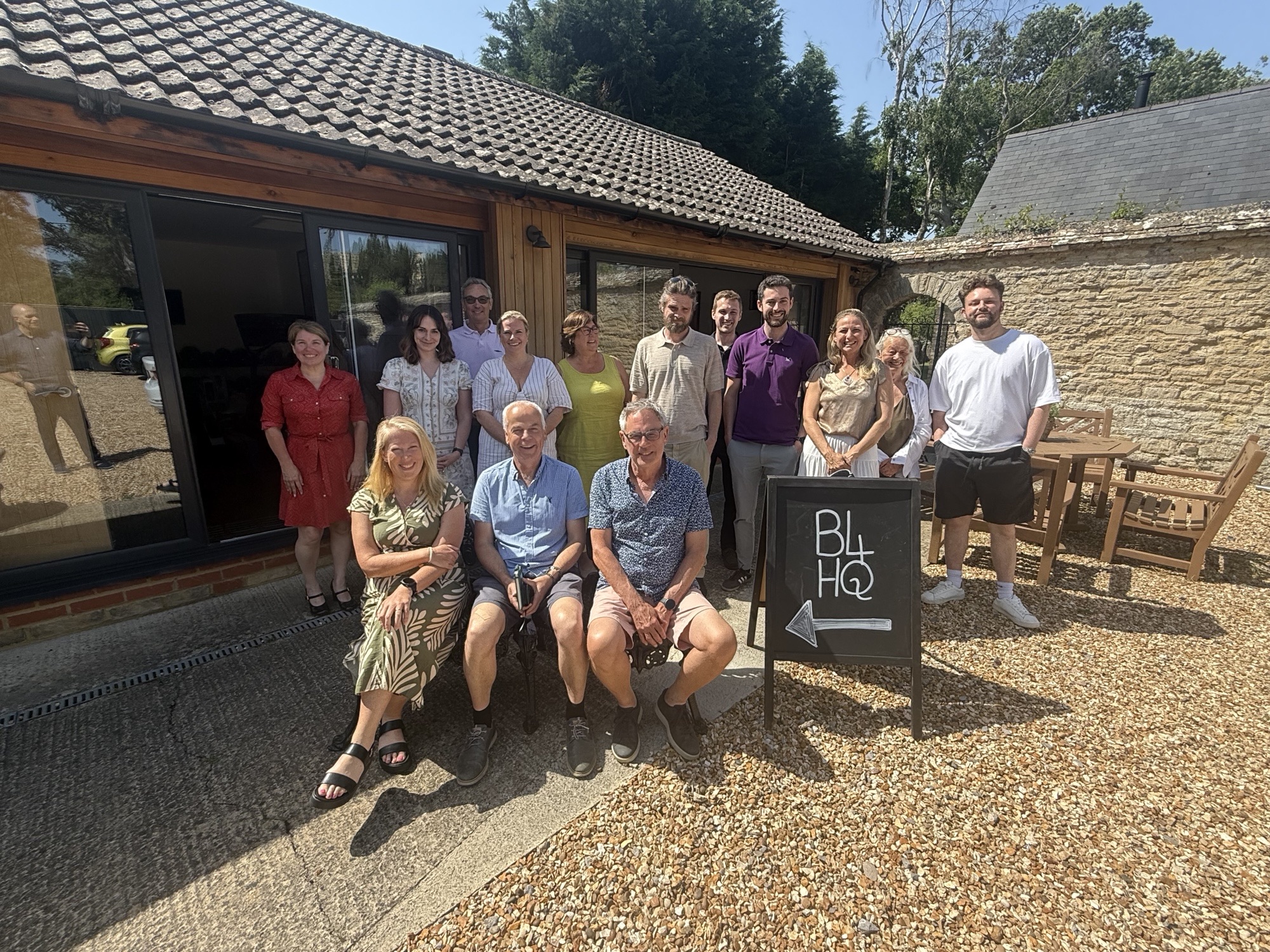
The launch of the B4 AI Ecosystem marked the beginning of a new series of collaborative discussions designed to help business leaders understand, adopt and maximise the opportunities presented by Artificial Intelligence.
Hosted at B4 HQ, the inaugural roundtable was led by Marnie Wills, founder of Business With AI Strategist, an AI Activist, Trainer and Strategy Consultant who works with organisations to embed AI into everyday business operations. Rather than viewing AI simply as another productivity tool, Marnie encourages organisations to develop practical AI strategies that enhance human expertise, improve decision-making and create capacity for innovation. Her work focuses on helping businesses build AI-powered operating systems through intelligent workflows, AI agents and responsible implementation that places people firmly at the centre of the technology.
The session brought together a diverse group of organisations representing professional services, finance, technology, charities, visitor attractions, environmental consultancy and transport. Organisations represented included B4, Be Free Young Carers, Digitizelectric, HMT LLP, Nicholsons, Plunkett UK, Price Bailey, Response, Royal Cars, The Story Museum and Thinking In Fields. The breadth of organisations around the table demonstrated that AI is no longer confined to technology businesses—it is becoming relevant across every sector of the economy.
AI is Moving Beyond Experimentation
One of the clearest messages from the discussion was that AI has moved beyond experimentation. Many organisations are now actively integrating AI into their daily operations, not to replace people, but to remove repetitive administration and allow teams to focus on higher-value work.
Participants shared examples of using AI to:
- prepare executive summaries
- draft funding applications
- create marketing content
- conduct market research
- analyse large documents
- support business development
- improve internal communications
- generate presentations and reports.
The discussion highlighted that organisations are beginning to see AI as another member of the team—a digital assistant capable of supporting employees rather than replacing them.
Human Expertise Remains Essential
A recurring theme throughout the session was that successful AI implementation depends upon combining technology with human judgement.
Marnie introduced the concept of the 20–60–20 approach:
- 20% human expertise and context
- 60% AI research, analysis and content generation
- 20% human review, refinement and decision-making.
The message was clear: AI is most powerful when guided by experienced professionals who understand their industry, customers and organisational objectives. Human expertise remains the competitive advantage.
Deep Research: One of AI’s Most Powerful Capabilities
One of the practical demonstrations that generated the greatest interest was Deep Research, now available across leading AI platforms including ChatGPT, Claude, Gemini and Microsoft Copilot.
Unlike a standard AI conversation, Deep Research enables AI to search hundreds of relevant sources, analyse information, cite references and produce comprehensive reports within minutes.
Delegates immediately identified opportunities to use this capability for:
- prospect research
- grant funding opportunities
- award submissions
- recruitment
- competitor analysis
- market intelligence
- property due diligence
- strategic planning.
For many attendees this represented one of the most valuable practical takeaways from the session.
AI Agents are Becoming Business Colleagues
The roundtable also explored the emergence of AI Agents—specialist assistants trained to perform specific business functions.
Rather than starting every conversation from scratch, organisations can now build AI agents using company knowledge, brand guidelines, previous work and standard operating procedures.
Examples discussed included:
- finance decision support
- business development assistants
- charity fundraising support
- media response drafting
- internal communications
- knowledge management.
The consensus was that these specialist AI agents deliver far more consistent results than general AI conversations because they understand an organisation’s processes, language and objectives.
Standardising AI Through Skills
Another emerging concept explored during the session was the creation of reusable AI “Skills”.
Instead of repeatedly writing prompts, organisations can create structured instruction sets—effectively digital Standard Operating Procedures—that teach AI exactly how particular tasks should be completed.
Examples included producing newsletters, outreach emails, reports and branded communications in a consistent style. This shift from prompt writing towards repeatable workflows represents the next stage in business AI adoption.
Looking Ahead: Vibe Coding
Delegates were also introduced to the concept of “Vibe Coding”, where natural language is used to build websites, presentations, interactive tools and applications without traditional programming knowledge.
Platforms such as Gamma, Claude Artifacts and Lovable demonstrate how AI is rapidly reducing the technical barriers to software development, allowing business users to create digital tools using simple conversational instructions.
Governance Cannot Be Ignored
Whilst enthusiasm for AI was evident throughout the room, participants also recognised the importance of responsible implementation.
Key concerns included:
- data security
- GDPR compliance
- confidentiality
- organisational AI policies
- copyright
- environmental impact
- misinformation
- ethical use
- public trust.
Several organisations are already developing formal AI policies and governance frameworks to ensure AI is adopted safely and responsibly across their teams.
Leadership, Learning and the Future of Work
The discussion concluded by looking beyond today’s AI tools and considering the future of work.
Rather than focusing solely on jobs that may disappear, attendees were encouraged to consider the new roles, services and opportunities AI will create.
Examples from organisations such as IKEA demonstrated how businesses are already using AI to reskill employees, improve productivity and develop entirely new products and services rather than reducing headcount.
The conversation reinforced that AI adoption should become a standing item within leadership and quarterly planning meetings, with organisations regularly reviewing:
- developments within their industry
- new AI capabilities
- workforce skills
- governance
- customer expectations
- future products and services.
Conclusion
The inaugural B4 AI Ecosystem demonstrated exactly what the series aims to achieve: creating a trusted environment where organisations can explore emerging technologies together, share practical experiences and learn from recognised experts.
Marnie Wills combined strategic insight with practical demonstrations to help delegates understand not only what AI can do today, but how leaders should begin preparing their organisations for tomorrow. Throughout the session the emphasis remained firmly on responsible adoption, continuous learning and ensuring that AI enhances rather than replaces human expertise.
Perhaps the most encouraging outcome from the discussion was the openness with which organisations shared both their successes and their concerns. Despite representing very different sectors, attendees discovered they were facing many of the same questions around governance, capability, security and organisational change.
As AI continues to evolve at pace, the B4 AI Ecosystem will provide an important forum for business leaders to continue learning, collaborating and ensuring that Oxfordshire businesses remain at the forefront of this technological transformation.
Visit www.b4-business.com to find out more about B4 Membership and joining members for Marnie’s next AI Ecosystem in September.++