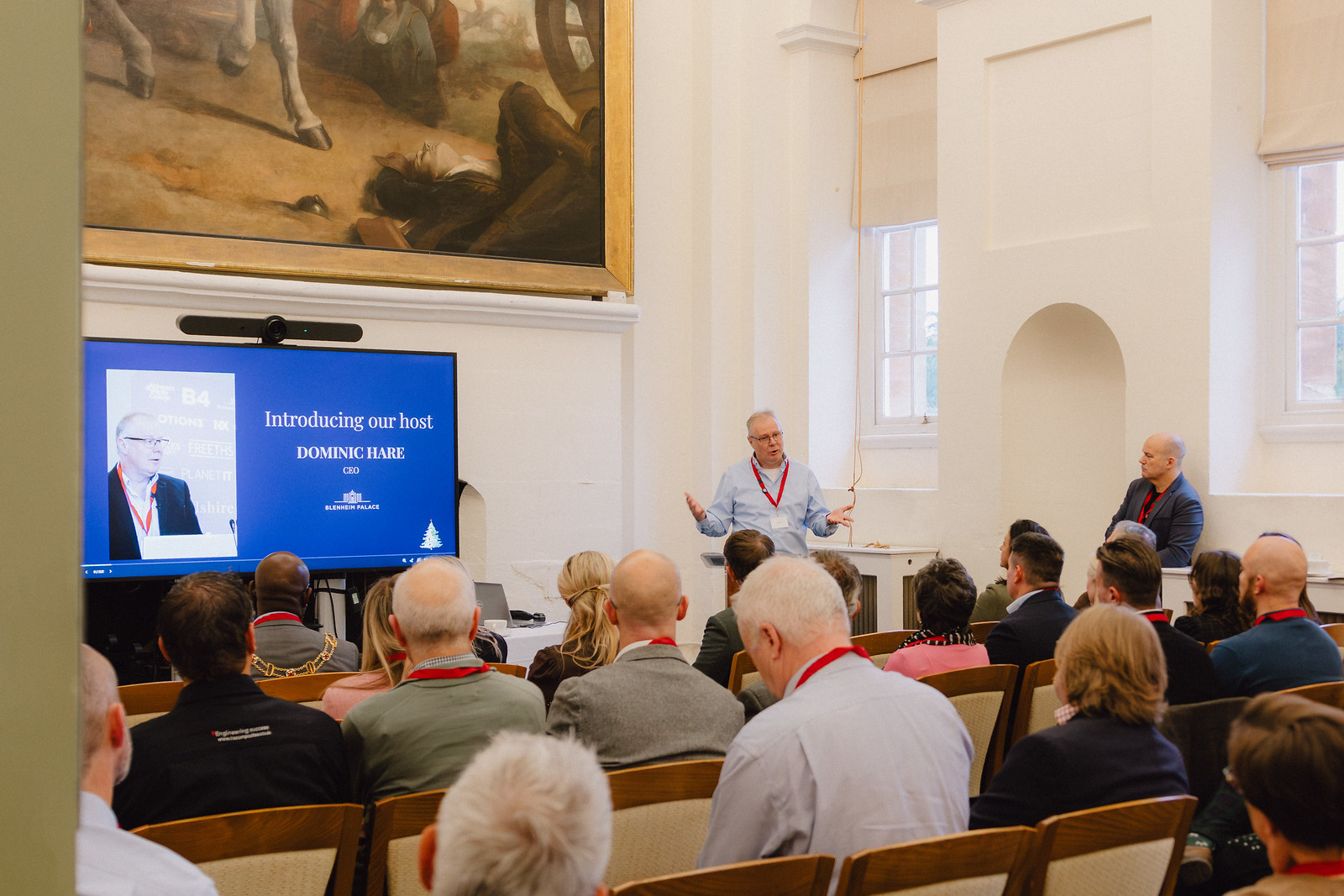
Dominic Hare, Chief Executive of Blenheim Palace, shares an insightful update with B4 members on the Palace’s transformation, the changing behaviour of visitors and why growing Oxfordshire’s economy is fundamental to Blenheim’s own success.
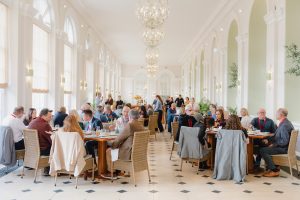
Blenheim Palace Chief Executive Dominic Hare delivered a characteristically engaging, candid and thought-provoking update to members of the B4 community at the 12th B4 Platinum Quarterly Breakfast, hosted at the Palace on Wednesday 4 November. From the completion of a major £12 million restoration project to the growing importance of artificial intelligence, changing visitor expectations and the Palace’s remarkable contribution to Oxfordshire’s economy, Dominic offered a fascinating insight into the challenges and opportunities of managing one of Britain’s most celebrated heritage attractions. At the heart of his presentation was a powerful message about transformation, collaboration and the importance of businesses working together to create a stronger local economy.
 Emerging from the chrysalis
Dominic opened with an entertaining analogy, comparing Blenheim’s recent transformation to a caterpillar becoming a butterfly. While both the caterpillar and butterfly can be beautiful, the transformation inside the chrysalis is considerably less attractive. It was, he suggested, an appropriate description of Blenheim’s current position. On a practical level, the Palace was in the middle of its rapid transition from Halloween to Christmas, with decorations and installations being dismantled and replaced.
But the analogy also captured a much bigger transformation. The previous evening, Blenheim had celebrated the completion of its £12 million roof restoration project, an undertaking that has dominated the past two years. During much of that period, the Palace was surrounded by an enormous scaffolding structure affectionately known as “The Beast”.
Rather than simply concealing the restoration work, Blenheim turned the project into a visitor experience, allowing more than 100,000 people to climb the scaffolding and see both the spectacular views and the intricate restoration work at close quarters. Nevertheless, Dominic acknowledged that operating a major visitor attraction through such extensive building works presents considerable challenges. Unlike some heritage properties that have been able to close during major renovations, Blenheim must continue trading while the work takes place. As Dominic explained, operating inside the chrysalis is an essential part of the business.
The challenge of increasingly unpredictable visitors
Turning to the wider visitor economy, Dominic highlighted a significant change in consumer behaviour. Where visitors might previously have planned a day out weeks in advance, many are now making their decisions on the morning itself. Weather forecasts have become disproportionately influential. Dominic described the frustration of seeing a forecast dominated by a rain-cloud symbol when the actual likelihood of rain might be relatively small or confined to an inconveniently displayed period overnight. For an attraction with substantial fixed operating costs, this increasingly last-minute decision-making creates major challenges. Staffing, catering, visitor services and operational resources must be planned in advance, even when demand can change dramatically within hours. The traditional approach to forecasting visitor numbers is no longer sufficient.
Using AI to make better decisions
 One of the most interesting aspects of Dominic’s presentation was Blenheim’s growing use of artificial intelligence and machine learning. The Palace is investing in sophisticated predictive analysis to better understand the relationship between weather conditions, visitor demand and operational requirements. Rather than focusing exclusively on longer-term forecasts, the business is increasingly interested in highly accurate short-term predictions. These allow teams to position staff where they are most needed and respond more effectively to changing visitor patterns. Importantly, Dominic emphasised that the objective is not simply to reduce staffing costs.
Instead, AI is being used to enable employees and the organisation to achieve more. The approach reflects a wider challenge facing businesses across Oxfordshire: how to combine technology, operational efficiency and a positive employee experience. For Blenheim, AI is becoming an increasingly important tool in managing that balance.
Rethinking the visitor experience
The changing behaviour of visitors is also prompting Blenheim to reconsider its pricing and overall proposition. Dominic explained that the traditional annual approach to pricing may not always reflect the way customers now make decisions. If visitors are choosing where to spend their day at very short notice, Blenheim must ensure that its offer represents compelling value at precisely the moment they are making that decision. This means looking carefully at the combination of attractions, seasonal experiences, events and year-round activities available across the estate. From Halloween and Christmas to the Palace’s permanent visitor experience, the challenge is to create a proposition that appeals to different audiences throughout the year.
From £80 million to £207 million: Blenheim’s growing economic impact
Perhaps the most significant revelation came when Dominic reflected on Blenheim’s ambitious ten-year strategy. In 2017, the organisation established a series of objectives focused on protecting and sharing the Palace, enhancing the lives of local people and making a greater contribution to the surrounding economy. One of its most ambitious commitments was to treble its contribution to the local economy over ten years.
Dominic revealed that this contribution has already increased from £80 million in 2017 to £207 million in the most recently measured year. Although the original target has not quite been achieved, the progress is substantial, with one final push remaining in the current strategic cycle. Crucially, this growth has not been achieved by simply trebling visitor numbers. Instead, Dominic attributed much of the progress to the strength of Blenheim’s relationships, partnerships and connections across the regional economy. He described the powerful network effect created when businesses grow together. The value of Blenheim’s assets, its commercial operations and its business relationships all increase when the wider Oxfordshire economy becomes more successful.
This is why supporting other organisations is not simply an exercise in corporate goodwill. It makes commercial sense. As Dominic explained, Blenheim cannot reach its full potential unless the businesses and individuals around it are also flourishing.
 Transformation rather than incremental improvement
Looking ahead, Dominic suggested that Blenheim has achieved its greatest successes when it has concentrated on genuine transformation rather than simply making incremental improvements. The completion of the roof restoration, the increasing sophistication of its operational systems and the progress towards its ten-year economic objectives all demonstrate that philosophy. As the Palace prepares to report formally on its strategic achievements and consider the next phase of its development, the emphasis remains on innovation, collaboration and long-term thinking.
For B4 members, the presentation offered valuable lessons extending well beyond the heritage and tourism sectors. How do established organisations remain relevant? How can technology improve decision-making without diminishing the importance of people? And how can businesses contribute to the success of their wider communities while strengthening their own commercial position? These were themes that resonated strongly with B4’s commitment to building bridges between businesses.
A shared commitment to Oxfordshire
 Dominic concluded by emphasising the importance of businesses recognising their mutual dependence. His message was that sustainable success is rarely achieved in isolation. Whether an organisation is a small independent business or one of Oxfordshire’s most recognisable institutions, its long-term prospects are strengthened by the success of the wider business community. It was a fitting conclusion to another memorable B4 Platinum Breakfast at Blenheim Palace and a powerful reminder of the value of collaboration.
B4 would like to thank Dominic Hare and the entire Blenheim Palace team for their continued support, hospitality and partnership and for providing another fascinating insight into the leadership of one of Oxfordshire’s most important organisations.
The 12th B4 Platinum Quarterly Breakfast took place at Blenheim Palace on Wednesday 4 November 2026.