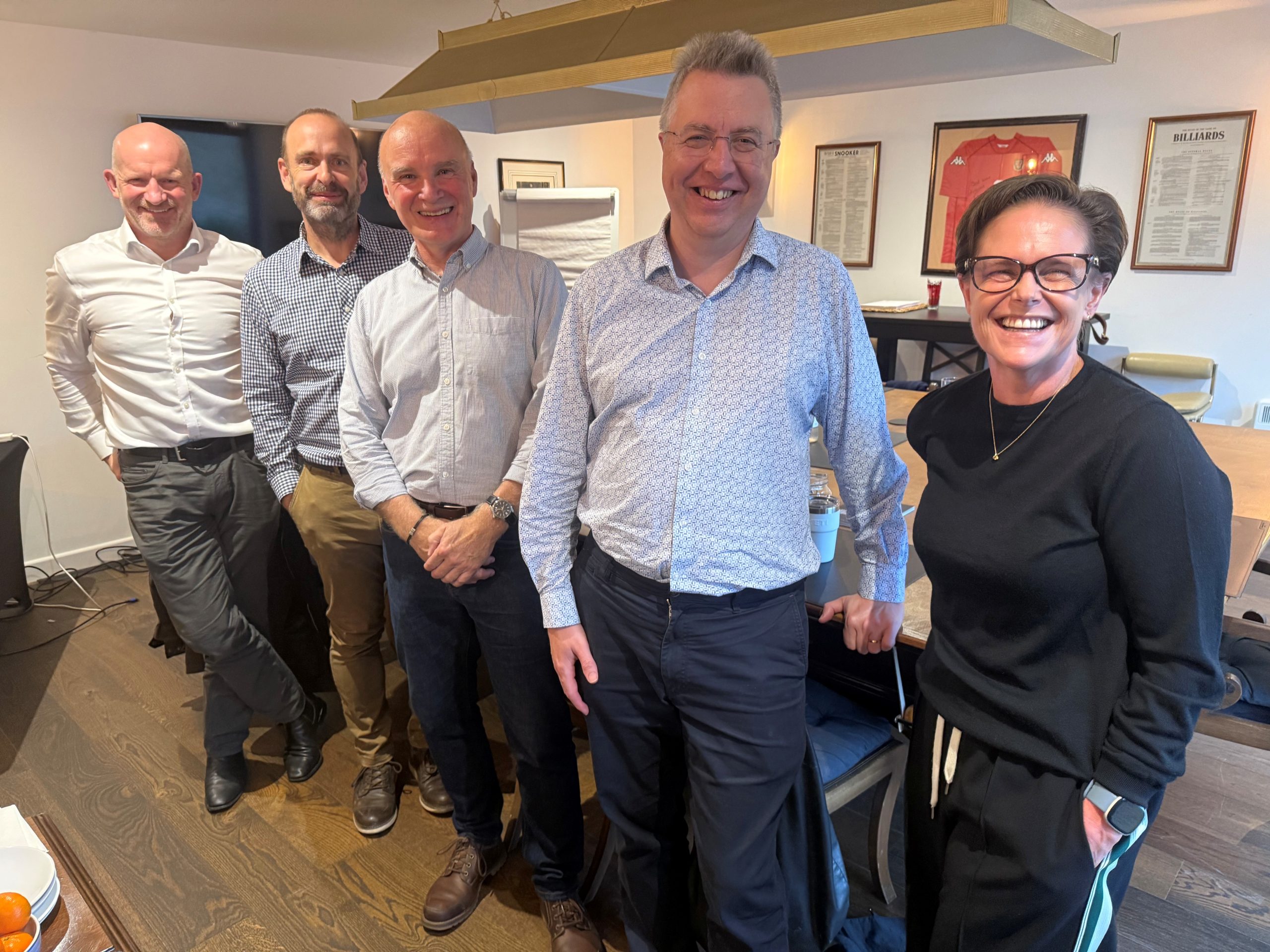
How do you build a team you genuinely trust? Not simply a team of capable people, but one that challenges constructively, makes good decisions when you’re not in the room, admits mistakes and can be trusted to do the right thing.
That was the starting point for a Corum Six hosted by Andy Whittard, former Managing Director of Cherwell Laboratories. The conversation quickly revealed that trust cannot simply be demanded. It develops through clarity, support, shared purpose and the behaviour of leaders themselves.
Management isn’t necessarily leadership
Andy introduced an interesting distinction between the different horizons people work towards. A supervisor might focus on today or next week, a manager on the coming quarter, while senior leaders must think one to three years ahead. Problems arise when someone is promoted but their thinking hasn’t been developed to match their new responsibilities.
Someone rewarded for operational excellence may suddenly be expected to think strategically without anyone explaining what that means. As the discussion highlighted, giving someone a new title doesn’t automatically equip them with a different perspective.
What does ‘be more strategic’ actually mean?
“Take ownership.” “Be more commercial.” “Think about the bigger picture.” These are familiar leadership phrases, but what do they actually mean to the person hearing them?
Claire Croft highlighted the importance of translating expectations into practical behaviours. If we ask someone to be more strategic, we should explain what they need to start doing, stop doing or approach differently. That sparked an entertaining discussion about business terminology, including the suggestion that Corum might benefit from its own glossary. We’ve included a shortened B4 Glossary of Business Speak below.
The serious message was clear: effective leadership requires language people can understand and act upon.
Have they failed, or have we failed them?
When someone struggles after promotion, it’s tempting to question their capability. But have we prepared them properly? As the discussion put it, people haven’t completed “a degree in telepathy.” Someone may have spent years successfully doing exactly what was expected, only to discover that the rules have changed.
Leaders need honest conversations about new responsibilities, expectations and the support available. Not everybody wants to manage people or move away from the work they enjoy. Sometimes an individual won’t make the transition, even with support. That requires honesty delivered with kindness, dignity and respect.
Competence gets you so far. Character takes you further.
Technical expertise matters, but senior leadership demands something more. Can individuals challenge constructively, accept criticism, acknowledge mistakes and contribute beyond their own specialism?
One memorable phrase described senior leaders as “strategists with a functional responsibility.” A Finance Director brings financial expertise, but also shares responsibility for the organisation’s wider success. Healthy debate matters, as does ensuring everyone understands the same objectives. Without that clarity, disagreements between departments can become personal when the real problem is competing priorities.
How quickly do people tell you the bad stuff?
Perhaps the simplest measure of organisational trust is how quickly people admit mistakes. In low-trust environments, problems are hidden until they become impossible to ignore. In high-trust environments, people feel confident saying something has gone wrong and asking for help.
Chris Ingram, Chief Executive of Style Acre, described his confidence in his senior leadership team and the tier below to make good decisions and communicate openly when something goes wrong. Trust also means information flows freely, rather than becoming something individuals protect. Ultimately, can you leave the room knowing your team understands enough to make sensible decisions without you?
Purpose gives people something to decide against
Purpose becomes powerful when it influences everyday decisions. An example from GSK involved a quality assurance team connecting its work to a young patient named Jack, asking: “What have you done for Jack today?” At Cherwell Laboratories, a similar principle emerged: “I want to be sure, because one day I might be the patient.”
Both connect individual responsibilities to meaningful human outcomes. Simon Blake shared an example from Price Bailey, where client “contact time” was encouraged alongside billable hours, helping advisers better understand what clients were trying to achieve. Purpose isn’t simply an internal statement. Understanding what matters to customers is equally important.
Culture needs connection
Angus Hone highlighted a phrase that resonated around the table: “culture needs connection.” This led naturally to hybrid working. Rather than debating whether office or home working is better, the discussion focused on why people should come together.
Informal conversations, observing colleagues and spontaneous exchanges all contribute to learning and relationships. But requiring attendance without a meaningful purpose doesn’t necessarily create culture. The challenge is to make connection valuable, rather than simply compulsory.
Culture is what people see you do
Chris described how he stays connected with Style Acre, which supports around 275 people and employs approximately 400 staff across Oxfordshire. At Christmas, he becomes Santa and makes a point of knowing the names of the people the charity supports.
Other examples included senior leaders unloading vans, clearing up after events and helping wherever needed. These small actions communicate something powerful: nobody is above contributing. Culture isn’t simply what leaders say matters. It’s what people see them doing.
Don’t rush the recruit
Recruitment, particularly at senior level, deserves more than an impressive CV and polished interview. By the time someone reaches a senior position, technical capability is often established. Character and behaviour become equally important.
Take candidates around the organisation. Introduce them to different colleagues. Observe how they interact outside a formal interview. One suggestion was particularly revealing: ask the receptionist how the candidate behaved when they arrived. How people treat those they don’t believe they need can reveal considerably more than another interview question. Skills can often be developed. Character is harder to manufacture.
Better conversations. Better decisions.
The discussion didn’t produce a neat formula for building trust. Instead, it reinforced that trust develops through clear expectations, shared purpose, appropriate support, healthy challenge and consistent leadership behaviour.
Perhaps leaders should regularly ask themselves: Have I explained what I expect? Does everyone understand why it matters? Have we prepared people for their responsibilities? Can they challenge me openly? Will they tell me when something goes wrong? Above all, are we creating the conditions in which our people can be at their best?
Trust cannot be demanded. But leaders can create the conditions in which it grows. And sometimes that begins with something as simple as saying what we actually mean.
The B4 Glossary of Business Speak
A light-hearted reminder that leadership language works best when everyone understands it.
| Leadership speak | What we probably mean |
|---|---|
| Be more strategic | Look beyond today’s problems and consider what comes next. |
| Take ownership | Take responsibility for moving something forward. |
| Be more commercial | Consider the impact on customers, costs and revenue. |
| Show more leadership | Provide direction and help others succeed. |
| Empower your team | Give people the confidence and authority to make decisions. |
| We need alignment | Agree on our objectives and act consistently. |
| Think outside the box | Consider alternatives to established approaches. |
| Let’s helicopter up | Step away from the detail and consider the bigger picture. |
The B4 rule? If you can’t explain what a phrase means in terms of something somebody should do differently, perhaps there’s a clearer way to say it.
Around the table
Hosted by Andy Whittard, former Managing Director of Cherwell Laboratories, the Corum Six brought together Andy Whittard; Richard Rosser, Chief Executive of B4; Simon Blake, Partner at Price Bailey LLP; Angus Hone of Stratagem IPM Limited; Chris Ingram, Chief Executive of Style Acre; and Claire Croft, Executive Coach and Culture Change Specialist.
A huge thank you to Andy for hosting and to everyone for contributing so openly.
About Corum Six: Corum Six brings small groups of senior leaders together for candid, peer-to-peer conversations. Members host discussions on challenges that matter to them, sharing experiences rather than presenting polished answers. If you’re a senior leader interested in experiencing Corum, please contact Richard Rosser at B4.
Corum. Better conversations. Better decisions. In person.