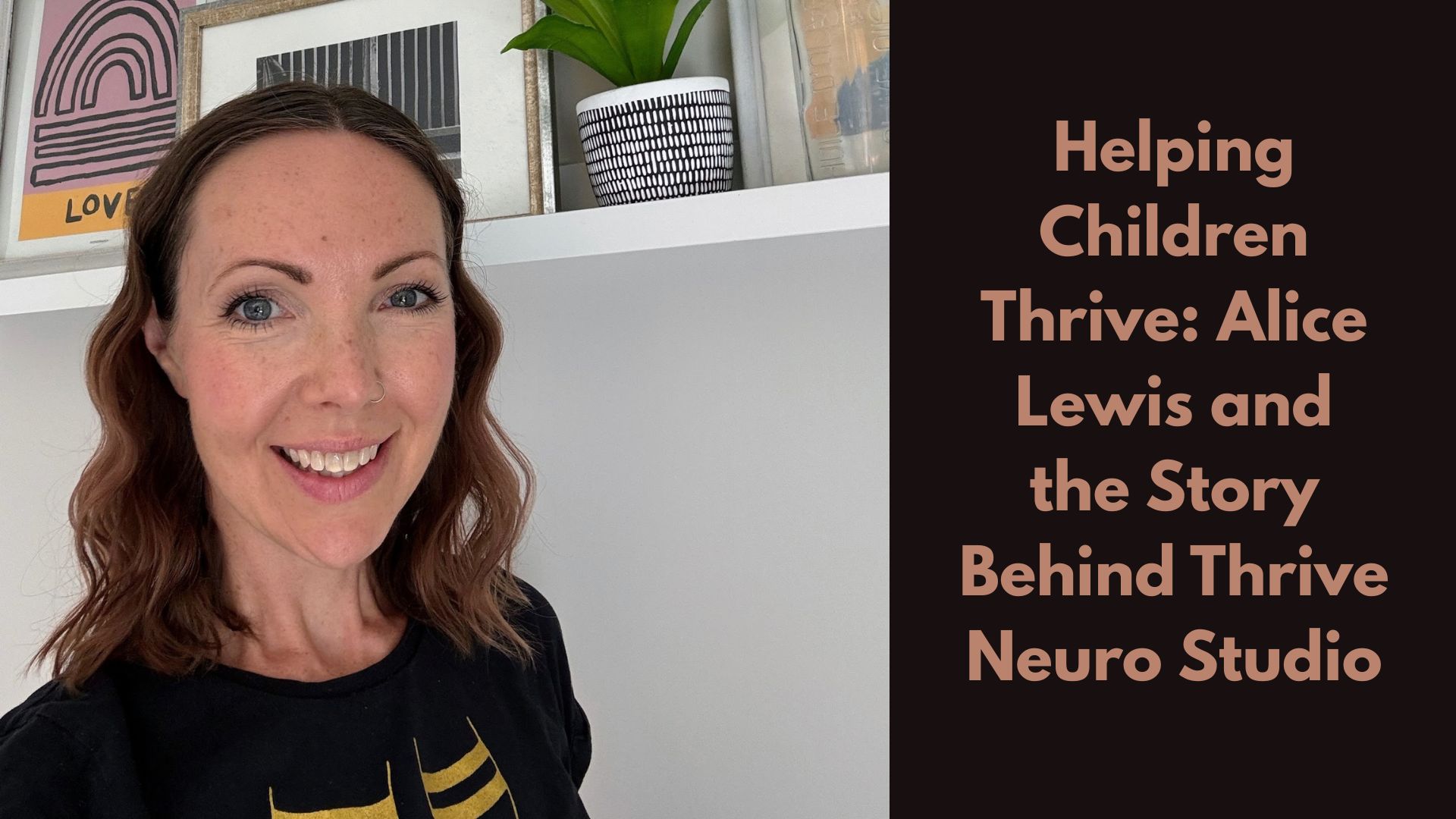
For Alice Lewis, the creation of Thrive Neuro Studio brings together almost two decades of experience in education, a passion for creativity and a very personal journey to understand why some children find everyday learning so difficult.
As a teacher with 16–17 years’ experience, including postgraduate study specialising in SEND, Alice has spent much of her career working with children and young people with a wide range of additional needs.
Over time, she began to notice something that increasingly frustrated her: while children and the world around them have changed enormously, the basic environment in which many are expected to learn has changed far less.
“We’re still asking children to sit still at a desk, look, listen and write,” Alice explains. “But for some children that simply doesn’t work. They need movement, they need things broken down into smaller chunks and they need different ways of engaging.”
That observation lies at the heart of Thrive Neuro Studio, through which Alice offers two complementary forms of support: creative tutoring for children and teenagers, particularly those with SEND, those being home educated or requiring alternative provision; and retained reflex therapy.
When learning becomes a struggle
Alice sees first-hand how children who struggle in a conventional classroom can respond very differently when given an opportunity to work creatively. As a teacher of 3D design and design technology, she has watched young people who find traditional academic work extremely challenging become absorbed in making, designing and problem-solving. “They might really struggle with the writing, but give them some wire and some wood and they can create amazing things,” she says. For Alice, creativity isn’t simply about producing something artistic. It can provide children with another route into learning, allowing them to experiment, solve problems, use their hands, make mistakes and develop confidence. It is this philosophy that underpins the creative tutoring side of Thrive. The second strand grew from an altogether more personal experience.
The experience that changed everything
When Alice’s daughter reached Year One, something changed. “Everything had been absolutely fine and then she just shut down completely,” Alice recalls. “She couldn’t concentrate, she struggled with friendships and she stopped reading. I knew there was something going on, but I couldn’t put my finger on it.”
Searching for answers eventually introduced Alice to the concept of retained primitive reflexes. Primitive reflexes are automatic movements present during infancy and are normally superseded as a child’s nervous system develops. Retained reflex therapy works from the premise that, where some of these early reflex patterns remain active, they may be associated with difficulties involving areas such as movement, coordination, concentration and aspects of learning. Alice decided to explore the approach with her own children. The experience had such an impact on her that she subsequently trained in the field herself. “With my daughter, the difference has been huge,” she says. “She’s reading and writing, her coordination is improving, she has a lovely group of friends and she’s loving life. Seeing my own children go through the process is what inspired me to train.” Her experience as both a parent and teacher now shapes the way she works with other families.
Looking beneath the behaviour
Alice is particularly interested in children who find concentration, coordination, emotional regulation, reading, writing or simply sitting still unusually difficult. Rather than looking only at the behaviour itself, her approach considers whether underlying developmental movement patterns may be contributing to those difficulties. Thrive uses several approaches within its retained reflex work, including gentle movement exercises, skin stimulation techniques and a sound programme concerned with auditory processing. The work is non-invasive and designed to take place gradually. Alice is also clear with families that it isn’t a quick fix: programmes can represent a significant commitment and may continue for around 18 months, with sessions initially taking place approximately every four to six weeks. That transparency is important to her. Prices are published on the Thrive website alongside information about the likely commitment involved, so parents can understand what they may be embarking upon before deciding whether to proceed. “I find it really frustrating when you visit a website and have to make a phone call just to find out how much something costs,” Alice says. “I wanted people to be able to see the information and decide whether it might be right for them.” An initial information call is free, giving parents and carers an opportunity to discuss their concerns and understand more about Alice’s approach before committing to a paid consultation or programme.
Supporting the child, not simply the diagnosis
Alice’s work is aimed at parents and carers who feel their child may need additional support, whether that child already has a diagnosis, is waiting for an assessment or simply appears to be finding particular aspects of everyday life and education difficult. Her teaching experience has also made her acutely aware that a label alone doesn’t necessarily tell a teacher or parent how best to help an individual child. “There are children who just cannot sit still,” she says. “Some need to stand or move around. As a teacher, you can give them tools and adapt what you’re doing, but I became interested in whether there were things we could do at a more foundational level to help them access learning.” Alice is continuing to develop that knowledge, including further training around movement-based approaches and how teachers can identify signs that a child may benefit from additional developmental support. Ultimately, she would like some of that understanding to find its way into classrooms too.
Building the foundations for children to thrive
The name Thrive sums up Alice’s ambition. It isn’t about forcing every child to learn or behave in precisely the same way. It is about identifying what might be getting in their way and finding practical, creative and supportive ways to help them move forward. For some children that might mean rediscovering confidence through creativity. For others it might involve exploring developmental movement and retained reflexes. For some, the two approaches may work alongside one another. Alice describes development as being rather like a series of connections on a circuit board: if something isn’t connecting as effectively as it might, other things can become more difficult. Her aim is to help children establish stronger foundations from which they can learn, develop and, appropriately enough, thrive. And behind the professional training and years of teaching experience sits perhaps the most powerful motivation of all: Alice has been the parent searching for answers herself. “I’ve seen my own children come through the other side,” she says. “And I’ve seen children I teach who have so much ability but find certain parts of school incredibly difficult. If we can give them another way to access learning and life, that can open so many more doors.”
Find out more
Parents and carers interested in learning more can contact Alice through the Thrive website or arrange an initial free information call to discuss their child and whether Alice’s approach could be appropriate.