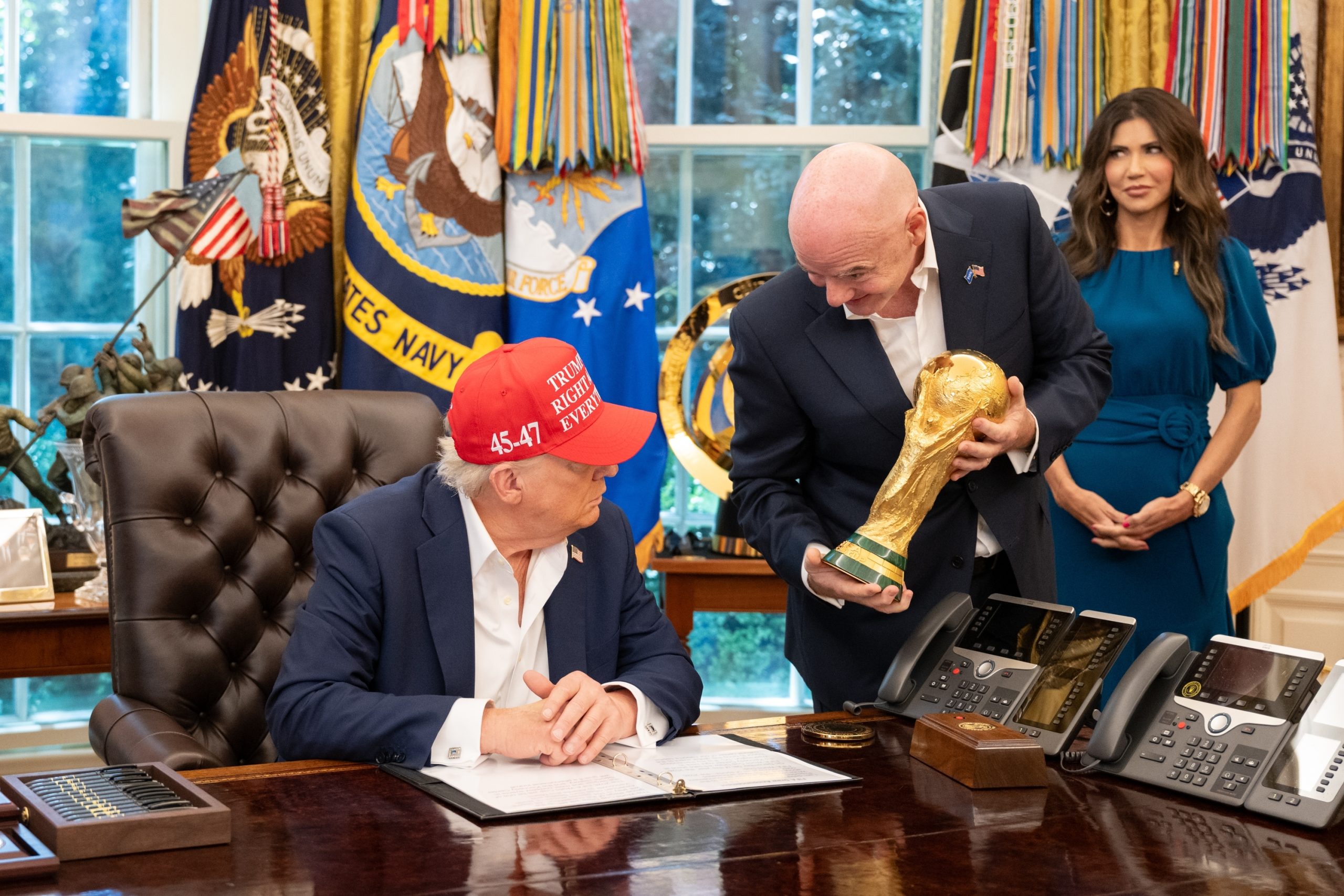
When Gianni Infantino succeeded Sepp Blatter as FIFA President in 2016, many football supporters believed the game was entering a new era. After years of controversy surrounding FIFA, he appeared to represent a fresh start – a modern, commercially astute leader who would restore confidence in world football’s governing body. By B4’s Richard Rosser.
For a while, many of us believed he had.
There is no question that under his leadership FIFA has become a commercial powerhouse. The recent World Cup was, by almost every financial measure, an extraordinary success.
But somewhere along the way, the balance appears to have shifted.
Having travelled across the United States to experience the World Cup first-hand this summer, I witnessed a great event. The atmosphere was unforgettable, the organisation was impressive and the football itself delivered everything supporters could have hoped for.
It was also one of the most expensive sporting experiences I have ever experienced.
Coughing up (almost literally) $98 for two beers and a small tray of nachos was the tip of the iceberg. ‘It’ll be the best beer you ever drink honey!’ the server said. It was certainly the most expensive!
For many supporters, attending a World Cup is a once-in-a-lifetime ambition. It should be about bringing nations together, celebrating the world’s game and creating memories that last forever. Instead, it increasingly feels as though football’s greatest tournament is becoming a luxury product, available only to those who can afford eye-watering prices. Like many others, I’m sure I was in the boat that was blowing the budget not living comfortably within it!
FIFA will argue that it is simply responding to demand. To a degree, that is true. However, there is a world of difference between responding to demand and creating mechanisms that encourage speculation.
The official secondary ticket marketplace, allowing tickets to be resold at vastly inflated prices while FIFA also benefits commercially, left me questioning whether football’s governing body has lost sight of the very people it claims to serve. We are constantly told that “the game is for the fans”, yet many genuine supporters are finding themselves priced out of football’s greatest stage.
That contradiction should concern everyone who loves the game.
My concern goes beyond ticket prices.
It is about the direction of travel.
Even before the final whistle had blown on the tournament, discussion had already turned to expanding the World Cup to 64 teams.
Whether that proposal ever materialises almost misses the point.
It illustrates a mindset that always seems to ask, “How can we make it bigger?” rather than, “How do we protect what makes it special?”
Where does it stop?
If 64 teams become acceptable, why not 80? Why not 128?
At some point football has to recognise that bigger does not automatically mean better.
There must be a line. Then there were the hydration breaks. Nobody disputes that player welfare must come first, particularly in extreme heat. But they became another reminder that football should never be forced to adapt to commercial ambition or scheduling at the expense of the spectacle. The game should always come first.
Perhaps the most troubling episode of the tournament, however, came away from the pitch.
Donald Trump publicly confirmed that he had contacted Gianni Infantino following Folarin Balogun’s World Cup red card and asked FIFA to review the decision. FIFA subsequently lifted Balogun’s suspension, maintaining that the process remained entirely independent.
Whether political influence affected the outcome is almost beside the point.
The perception was damaging.
FIFA should never allow supporters to believe that political access might carry greater weight than the disciplinary process itself.
Contrast that with England defender Jarell Quansah, whose dismissal against Mexico resulted in a two-match (not one as it arguably should have been) suspension that ruled him out of England’s quarter-final and potential semi-final.
You may agree or disagree with either decision.
The point is consistency.
At the highest level of world football, decisions must not only be fair—they must be seen to be fair. Anything less undermines confidence in the competition itself.
The optics surrounding football’s leadership have also become increasingly uncomfortable.
Seeing Donald Trump standing alongside Gianni Infantino during the Club World Cup Final trophy presentation blurred the lines between football and politics in a way many supporters found unnecessary.
I don’t blame President Trump.
Any political leader would relish the opportunity to share the stage at one of the world’s biggest sporting occasions.
The responsibility rests with Gianni Infantino.
The FIFA President should be protecting football’s independence, not creating the perception that politics is becoming part of the show’s centrepiece.
Now comes the latest proposal – exploring outside investment in the commercial rights of the World Cup. This is where the line has to be drawn.
Thank goodness UEFA and its 55 member associations have made an early and united stand. As Prime Minister Andy Burnham rightly said, the World Cup is not for investors.
He is absolutely right.
Aleksander Čeferin has shown the sort of leadership many supporters want to see. Whether or not everyone agrees with every UEFA decision, as President he has consistently demonstrated a willingness to protect football’s traditions and challenge proposals that threaten the long-term interests of the game. If football is looking for leadership that commands confidence and puts the sport ahead of relentless commercial expansion, he has shown he is among the very best people to lead that fight.
The FIFA World Cup is not another commercial asset to be packaged, leveraged and sold to the highest bidder. It is football’s holy grail. It belongs to the nations that compete, the supporters who fill the stadiums and the billions who watch around the world.
What’s next? The Pepsi World Cup? The Budweiser World Cup? National teams becoming advertising platforms? International shirts carrying corporate sponsors?
It may sound far-fetched, but football has spent decades accepting commercial changes that once seemed unimaginable. Every change has generated more revenue.
Eventually someone has to say: Enough.
Gianni Infantino deserves genuine credit for strengthening FIFA commercially.
But leadership is not simply about generating more income. It is about recognising when the pursuit of revenue begins to threaten the very thing that makes your organisation valuable in the first place.
Increasingly, Gianni Infantino reminds me of a Bond villain – put a cat on his lap and you’d think he was. That is, of course, a metaphor rather than a personal accusation, but it reflects my growing concern that football’s greatest competition is becoming an ever-larger commercial enterprise rather than something to be protected for future generations.
I hesitate to put this in writing, but one further concern lingers in my mind. Could commercial pressures eventually lead to calls for the World Cup to be staged more frequently? I sincerely hope not.
Thankfully, the UEFA European Championship (and other global championships) provides a natural counterbalance in the international calendar, making a biennial World Cup highly unlikely. But football has changed dramatically over the past two decades in ways many of us once thought impossible.
The unthinkable has a habit of becoming the accepted. That is why football needs strong leadership. UEFA has shown that leadership.
Now the wider football world—confederations, national associations, clubs, players and, above all, supporters—must unite to defend what makes the World Cup unique.
Some things simply should not be for sale.