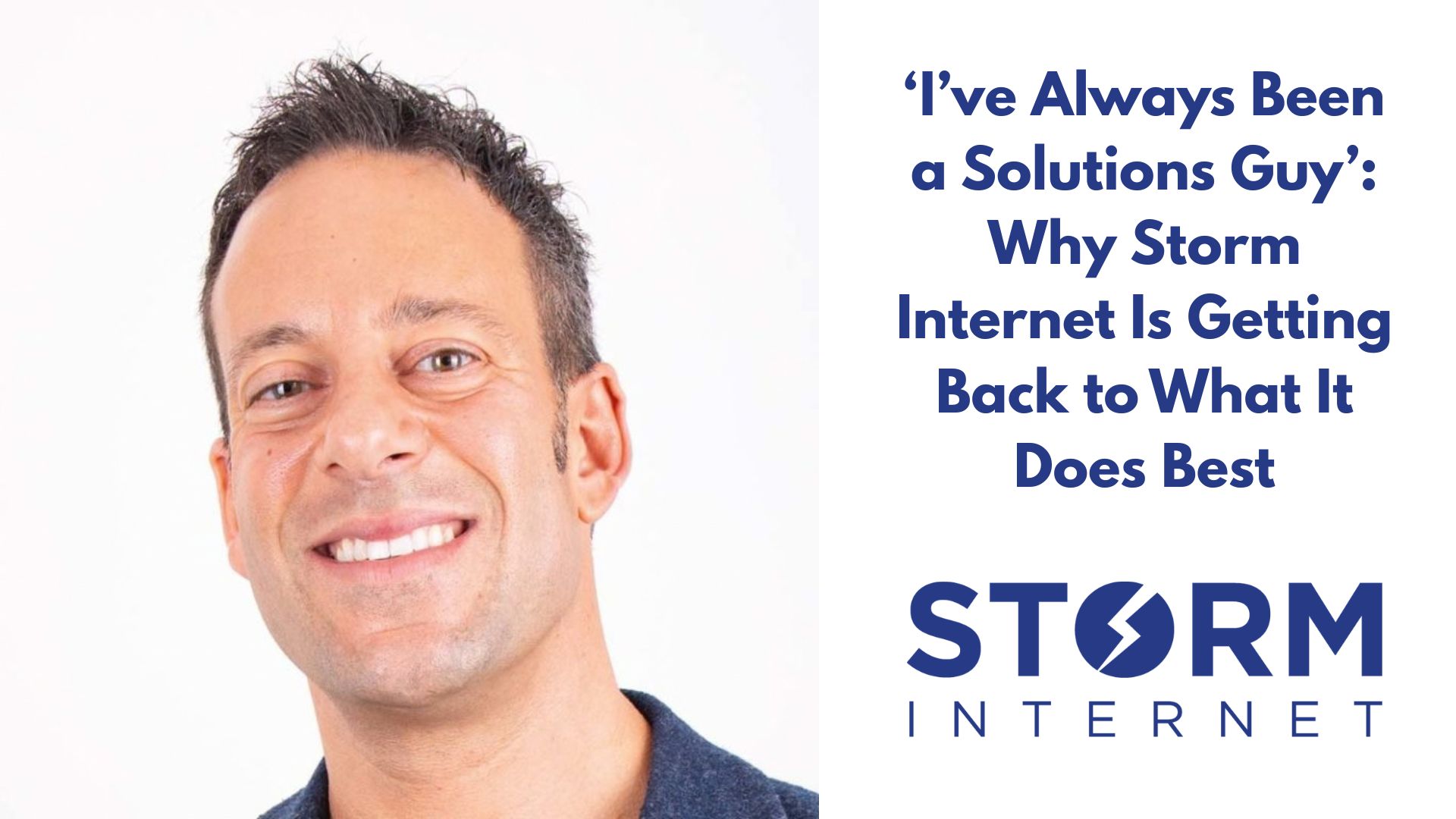
Ask Salim Benadel what excites him about servers and you might be asking the wrong question. Ask him about solving a problem that is keeping a business owner awake at night and you’ll get a very different reaction.
“I’ve always been a solutions guy. I like helping people and fixing problems.”
That, in one sentence, probably tells you more about Storm Internet than a page of server specifications ever could. And, according to Salim, that’s partly the problem.
For more than 15 years, Storm has been looking after hosting and cloud infrastructure for businesses. It has the technology, its own infrastructure, 24/7 support and a team that knows what it is doing. But somewhere along the way, Salim believes Storm started sounding a little too much like everybody else: servers, memory, disk space, processing power and hosting packages. All important. All, frankly, a little dull.
“We’re not really just selling servers. We never really were, but we probably sounded like we were.”
So Salim and the team have spent time asking themselves a much more fundamental question: what are we actually useful for?
The answer has taken Storm right back to why Salim got into technology in the first place.
Forget the server. What’s the problem?
Salim loves technology. That’s obvious when you talk to him. But what really seems to animate him is what technology can do.
“I got into IT because I actually love the industry. I like technology and I like solving problems with technology. That’s always been what Storm is about. How can we help people?”
That thinking has prompted something of a reset at Storm. Instead of asking a prospective customer whether they need a server, Salim would much rather ask: what have you got that absolutely cannot stop working?
That might be an application generating revenue, a portal customers depend on or simply a database used by six people in an office. If those six people can’t work when it goes down, Salim’s interested. That’s business critical.
And then there were the sandwiches…
Perhaps the best example Salim gives is also the least glamorous: sandwiches.
Storm hosts systems developed for the NHS which at one point included lunchtime ordering software. Every morning at around 10am, people would start putting in their lunch orders.
“If the system went down at 10 o’clock, that’s going to cause havoc come lunchtime.”
It raises a smile, but it illustrates his point perfectly. A piece of technology doesn’t have to sound enormously sophisticated to be enormously important to the people using it. Once a business relies on something, somebody needs to make sure it keeps working. That’s where Salim believes Storm earns its keep.
The 3am test
There is another detail Salim mentions almost in passing which says rather more about Storm than any specification sheet could. Storm provides 24/7 cover, which means, as he puts it, “we’ve got a chap who’s literally sat there at 3:00 in the morning” keeping an eye on things.
Hopefully, he’s having a very quiet night. But that’s rather the point.
For years, Storm tended to present that level of support as something that came with the hosting. Salim now thinks they had it the wrong way round. The support is the product. The server is just one of the tools.
That realisation came into sharp focus when a prospective customer approached Storm about a server in Oman. Storm initially assumed the conversation was going to be about hosting it. It wasn’t. The customer already had the server; what they didn’t have was somebody they trusted to look after it.
“That was the big turning point. We realised that when we lead with the value of our support service, it’s valued at a lot more than if we just lead with the specs.”
Three things that really matter
Salim being Salim, he then went looking for the evidence. Storm went back through more than 15 years of customer support requests to understand what people actually worried about.
Strip away the technical language and most of it came down to three things: is it working, is it secure, and if something goes horribly wrong, can you get it back?
Availability. Security. Recovery.
That’s now at the heart of Storm’s thinking. “Every decision we make now is: how does it make availability better for someone? How does it make things more secure? How can we protect them better from data loss?”
If a new piece of technology doesn’t improve one of those things, Salim isn’t particularly interested. If it does, he is.
Enter Azure
Which brings us to Microsoft Azure. Storm has recently added Azure to its capabilities, but Salim is almost determined not to sell it to everyone.
“We’d never just put someone on Azure because we’re offering it now.”
That’s not a sentence you’ll necessarily hear from every technology provider, but it makes sense when you understand his philosophy. Storm already has its own private cloud infrastructure in the UK and, for many customers, that is exactly what they need.
For others, Azure opens up possibilities Storm couldn’t previously provide. A business might need its application spread across multiple data centres, another might experience enormous surges in demand, while another might want part of its operation in the public cloud while keeping particularly sensitive data on Storm’s private UK infrastructure.
Azure simply gives Storm another tool. As he puts it: “I’m not a tradesman, but I’m sure a builder or carpenter would say, ‘I wouldn’t use that tool for this job, but I’d use this one.’”
Right tool. Right job. Right solution.
From ‘How fast is it?’ to ‘How secure is it?’
The evolution of Storm also tells an interesting story about how dramatically business technology has changed.
When Salim started out, one of the questions customers regularly asked was: “How fast are the servers?” Today, he says, we hardly ever hear that question. Now it’s: “How secure are they?”
Businesses understand cyberattacks, data breaches and the consequences of losing access to a critical system. Even backup has finally become interesting. Well, almost.
“Backup was one of the hardest things we had to sell. People didn’t really care because it didn’t shine. It wasn’t a feature. It didn’t make the thing faster. Backup is boring.”
Until, of course, you need it. Then it becomes possibly the most exciting thing you’ve ever bought.
‘We’re not for everyone’
There is something else refreshingly straightforward about Salim’s approach. He doesn’t want everybody’s business.
“If you have just a standard website where you don’t need the business-critical aspect, I’ll be honest, there are probably other providers that might be better suited.”
Storm remains firmly focused on SMEs, but increasingly on those with something important at stake: something that generates revenue, something their customers depend on, something their team needs to do its job or something where, if it suddenly disappeared tomorrow morning, somebody would say: “We’ve got a problem.”
Those are the conversations Salim wants because, after more than 15 years in technology, Storm isn’t trying to become the company with the longest list of services. It’s trying to become clearer about why it exists.
Salim sums it up rather neatly: “You know who you’re pitching to. You know what your value is.”
Perhaps that’s a lesson that extends well beyond technology. Storm Internet may deal in clouds, servers, security and backups, but Salim deals in problems. And, judging by the enthusiasm with which he talks about them, that’s exactly where he wants to be.
Got something that absolutely can’t go down?
If your business relies on an application, portal, database or cloud-based system that would cause a serious problem if it stopped working, Salim and the Storm Internet team would be happy to have a conversation.
And don’t worry if you don’t know whether you need Azure, private cloud, hybrid cloud or something else. That’s rather the point. You bring the problem. Storm would much rather work out the solution.
Find out more: www.storminternet.co.uk
Get in touch: 0800 817 4727 | solutions@storminternet.co.uk