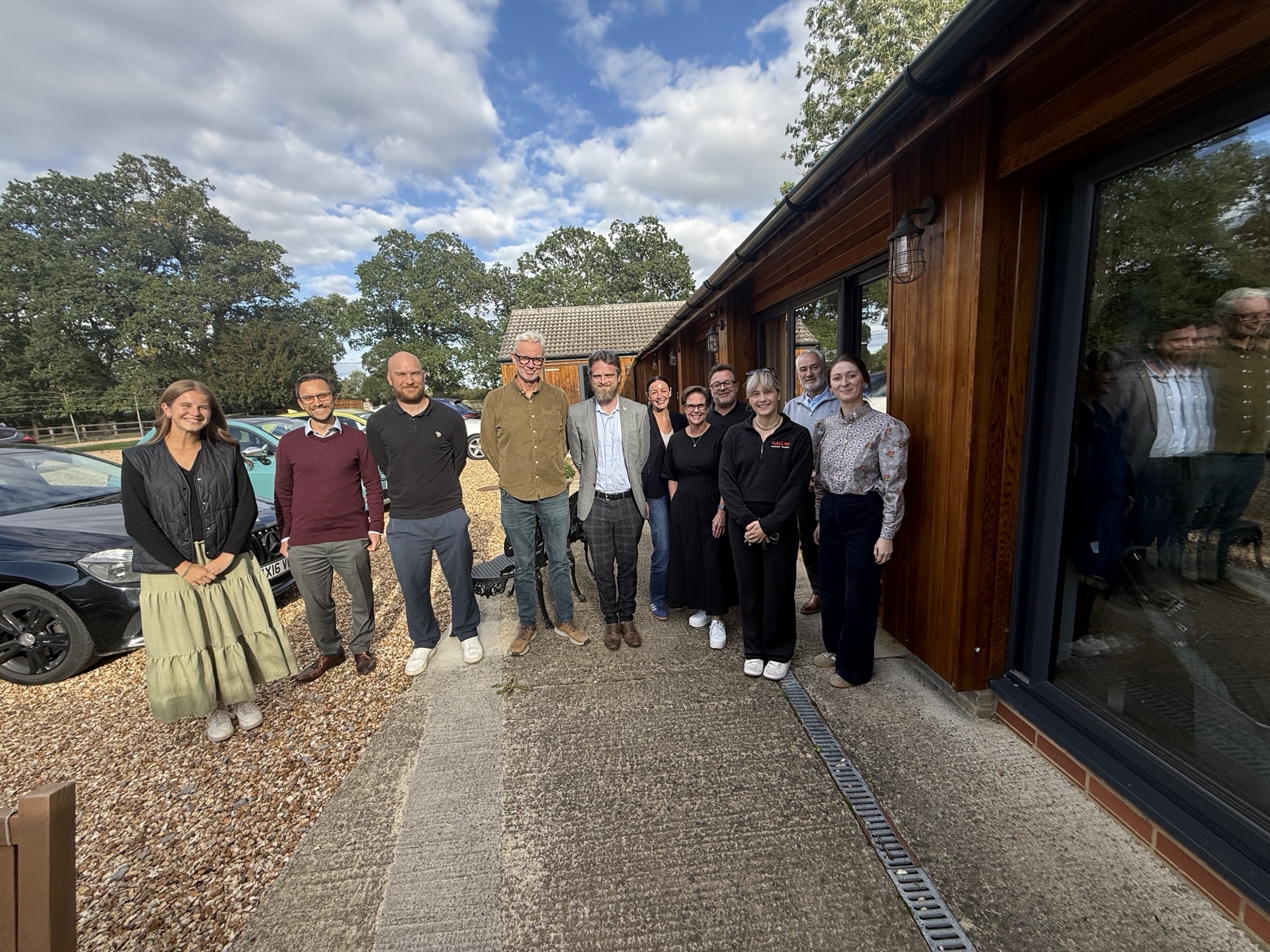
At the latest B4 PEOPLE Ecosystem Roundtable, executive coach and culture change consultant Claire Croft brought B4 members together to explore what makes teams work — and why some of the answers may lie outside the team itself.
What is the weather like in your team right now?
Sunshine? Clouds gathering? Changing seasons? A storm brewing? Or perhaps all four in the same day?
That was the deceptively simple question Claire Croft used to open the latest B4 PEOPLE Ecosystem Roundtable at B4 HQ on Thursday 17 September.
It immediately got people talking. Around the room were businesses and organisations of very different sizes and from very different sectors. Yet the weather reports revealed many of the same pressures: growth, recruitment, changing structures, succession, communication challenges, busy teams, shifting expectations and the constant need to keep people aligned. Some were enjoying sunshine. Others could see sunshine appearing after a period of change. Some were experiencing more unsettled conditions. And that provided the starting point for a fascinating two-hour discussion.
What makes a great team?
Claire, an executive coach and culture change consultant who has spent 14 years coaching leaders and teams, began by asking the group to reflect on the best — and worst — teams they had experienced.
The discussion quickly identified many of the factors we all traditionally associate with shaping the performance of a team: leadership, trust, the quality of communication within the team, how individual performance is or isn’t managed, how well challenges and conflict are navigated, the level of clarity around roles and responsibilities. All important. But Claire then challenged the room to consider whether we spend too much time looking inward when trying to improve our teams. Her central point was simple:
“No team is an island.”
Every team exists within a much bigger system. There are colleagues, other departments, customers, suppliers, partners, communities, investors, regulators and countless other stakeholders. Their expectations can significantly impact how a team thinks, feels and behaves – and ultimately how successful it can be.
So rather than starting with: How can we work better together? Claire encouraged the room to start somewhere different: who are we here to serve? What do they need from us? And what impact do we want to achieve?
 Looking from the outside-in
Traditional team development often begins internally – personalities, processes, structures, leadership styles, behaviours and relationships. All valuable to consider but Claire argued that it becomes significantly more powerful to consider them once there is first a shared understanding of what the team is actually there to achieve for the people around it.
The discussion produced plenty of examples of what happens when a shared ambition is missing. Sales teams can promise something which operations then struggle to deliver. Different departments can give a customer completely different answers. Decisions can be made that are right for the team but wrong for the wider business. Teams within the same organisation can inadvertently compete against one another – all of which only makes the whole organisation less effective.
Why it matters
One of Claire’s strongest observations was the positive impact of an outside-in approach on people’s energy and motivation to fulfil goals:
“Working with a shared ambition gives goals context.”
Targets matter. Revenue matters. Profitability matters. KPIs matter. But a numerical target on its own doesn’t necessarily give someone a reason to care about achieving it. Feeling like the goals are in service of something, like making a positive impact, does.
This approach doesn’t require a team to have a grandiose, “change the world” style purpose. It could be about becoming the most innovative business in your sector, giving customers a consistently outstanding experience, improving people’s health, creating better places, helping a community thrive or simply making someone’s day easier. The important point is that people understand what their work is in service of.
One example discussed was a business which had moved the conversation away from simply achieving a financial target towards the number of people it wanted to positively impact. The commercial ambition hadn’t disappeared. Instead, the team had been given a much clearer human context for achieving it. That distinction matters. When people understand the impact they are collectively trying to make, individual objectives begin to connect to something bigger.
Any team can start to embrace an outside in perspective by asking four simple questions
Who are our stakeholders?
What do they expect from us?
What impact do we want to achieve for them?
Are we consistently delivering that right now?
The answers can reveal some important opportunities to improve ways of working and engaging both inside and outside of the team.
Breaking down the silos
Looking outside-in also changes the way different teams and departments think about one another. If success is defined only by individual or departmental targets, it is easy for silos to form. But, if success is defined by the impact the organisation wants to create for its stakeholders, the conversation changes.
Instead of “did our department hit its number?” it becomes “did we all collectively deliver what the customer, client, beneficiary or community needed from us?”
Claire described this as more horizontal thinking across an organisation, rather than everyone concentrating solely on what is immediately above or below them. It can also depersonalise difficult conversations – challenge becomes less about one person being right and another being wrong and more about whether a decision helps the organisation achieve the shared ambition everyone has agreed upon.
Leadership doesn’t mean having all the answers
The discussion inevitably came back to leadership, and Claire offered another thought which resonated strongly around the table:
“The job of leadership is not to have all the answers. It’s to create the conditions in which answers can be found.”
Something which is especially true when seeking to focus on serving stakeholders and achieving a positive impact for them – that is a collective endeavour not a task for a leader alone.
One participant described how their leadership approach had evolved from identifying a problem and presenting the team with the solution, to allowing the problem to emerge, discussing it together and enabling the team to develop the answer. Claire reinforced the point:
“You don’t need to solve all your team’s problems. They need to feel enabled to solve it for themselves.”
For leaders accustomed to being the person everyone looks to for the answer, that can require a significant shift. But it creates ownership, develops people and ultimately builds teams who are more capable of achieving a positive impact.
 Learning together
The final element of Claire’s approach was perhaps one of the easiest to overlook: teams need to create space to learn together. To ask important questions such as: What are stakeholders telling us? Are we achieving the impact we intended? What has changed? What isn’t working? Are the processes and behaviours we established six months ago still the right ones today?
This isn’t a one-off strategy exercise. It is an ongoing conversation between ambition, strategy, goals, processes, culture, stakeholder relationships and learning. Sometimes slowing down long enough to have those conversations is precisely what allows a team to move faster afterwards.
One conversation to take back to your team
As the afternoon drew to a close, Claire left everyone with a practical challenge: what is the one conversation you could have with your team about what your stakeholders really need from you? And what would it be great to be able to say you were achieving for those stakeholders — beyond the numerical goals and targets?
Perhaps that is the conversation which begins to change the weather in the team.
Because one of the most reassuring conclusions from the afternoon was that, despite the extraordinary range of organisations represented around the table, many of the challenges were remarkably similar.
As Claire put it: “Humans are humans. It’s just the context that changes.”
That is precisely why the B4 PEOPLE Ecosystem exists.
Bringing people from different sectors together creates the opportunity to step outside the day-to-day pressures of our own organisations, hear how others are tackling similar challenges and return to our teams with a different perspective.
And on this occasion, perhaps the most useful perspective was quite literally to look from the outside in.