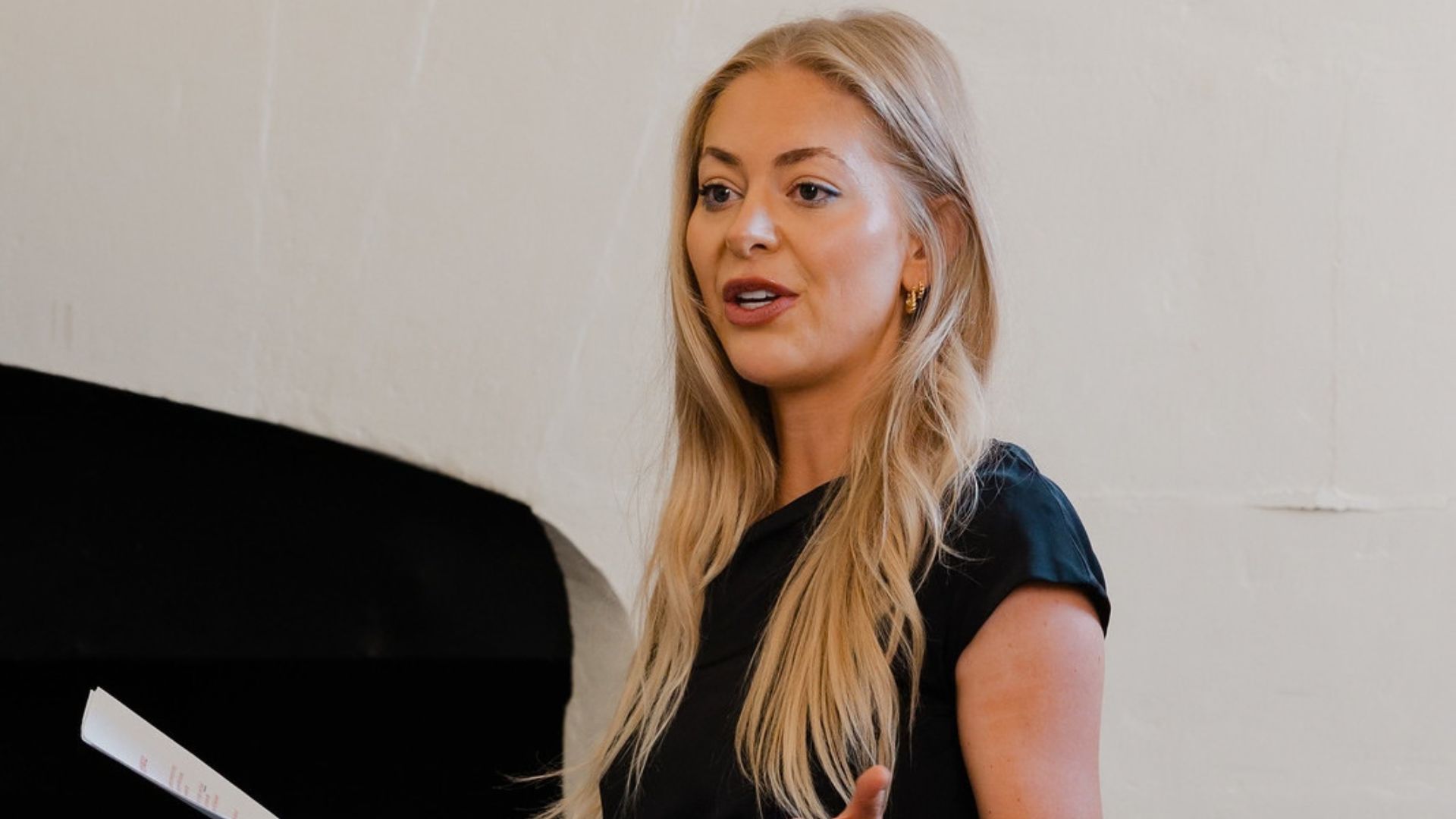
At the latest B4 Platinum Breakfast, Avra founder and CEO Georgie Spurling shared a deeply personal story with a much bigger message for business leaders: health and wellbeing cannot continue to sit on the sidelines — either in our personal lives or within our organisations.
For Georgie Spurling, wellness isn’t an abstract concept or simply the industry in which she happens to work. It has shaped almost her entire life. Speaking to B4 Platinum Members, Georgie began by taking the audience back to 1998, when, at just four years old, she underwent major heart surgery at Guy’s and St Thomas’ Hospital. Afterwards came a sentence that would shape the next three decades of her life.
“She will never be able to exercise.”
At four, Georgie didn’t fully understand what that meant. As she grew older, however, its significance became much clearer. It wasn’t simply that sport was unavailable to her. She described a childhood spent watching from the sidelines while friends took part in PE lessons, sports days and netball matches.
“It’s not just physical, it’s identity,” she explained. Being constantly protected taught her to think of her body as something fragile — something to be managed rather than lived in. But watching from the sidelines also gave Georgie an unusual perspective. She noticed what exercise did for everyone else: the change in mood after activity, the confidence that came from feeling physically strong and the way movement could transform a difficult day. Long before she was able to test those ideas herself, she was observing the relationship between movement, physical health and mental wellbeing.
From the Sidelines to a New Direction
At 17, Georgie decided to challenge the expectations that had surrounded her since childhood by taking up dancing. It wasn’t, she stressed, a reckless decision. She started carefully, listened to her body and gradually discovered that it was capable of more than she had been led to believe. Her heart didn’t suddenly become “fixed”. Georgie was careful not to present her experience as a medical fairy tale. Instead, it adapted.
“I gave my heart a job to do rather than a big fat warning label to wear.”
That discovery became the beginning of a much bigger journey. Georgie trained, studied and ultimately built a career around understanding how bodies respond to movement, stress, illness and fear. She became particularly interested in helping people who were often poorly served by the traditional fitness industry — including those with chronic conditions and injuries, as well as people whose stress levels and overloaded nervous systems made conventional approaches to exercise unrealistic. Eventually, those experiences contributed to the creation of Avra, the wellness platform she founded around a simple principle: wellness should not be reserved for those who already have the time, confidence and money to access it.
A Health Problem That Has Become a Business Problem
 Georgie’s personal story provided the backdrop to a wider warning. She argued that what happened to her as a child — being left on the sidelines of physical activity — is now happening on a much larger scale. Except today, many of us are putting ourselves there. The consequences, she argued, can be seen not only in individual health but throughout the economy and workplace.
During her presentation, Georgie highlighted the enormous number of working days being lost to sickness absence in the UK and the financial impact associated with poor health. Mental health difficulties, musculoskeletal problems and stress-related illness all contribute significantly. But absence tells only part of the story. Georgie encouraged business leaders to pay particular attention to presenteeism — employees who are technically at work but aren’t sufficiently well to perform at their best.
Her message to the room was direct: “That is not a wellness problem sitting quietly in HR. That is a performance problem sitting in your P&L.”
It was an important distinction. For many organisations, workplace wellness still exists around the edges of the business: gym discounts, occasional yoga sessions, wellbeing weeks or initiatives which can disappear when budgets tighten. Georgie’s argument was that this fundamentally underestimates the issue.
If the health of employees affects absence, retention, productivity and performance, then workforce wellbeing is not simply an employee benefit. It is part of business infrastructure.
Wellness Is More Than Going to the Gym
One of the central themes of Georgie’s talk was the need to rethink what we actually mean by “wellness”. The industry, she argued, has a tendency to reduce it to individual solutions: exercise, diet, mental health, supplements or whatever the latest trend happens to be.
Avra instead approaches wellness through five interconnected dimensions:
Movement, nutrition, mindfulness, self-development and recovery.
The important word is interconnected. Someone can exercise regularly and eat extremely well, for example, but still struggle if they are sleeping for four hours a night and living under constant stress. Equally, focusing solely on mental wellbeing without considering physical activity, nutrition, purpose or recovery misses part of the picture. For Georgie, recovery is perhaps the most overlooked element of all. Sleep, rest and allowing the nervous system to come down from a constant state of alert can determine whether progress elsewhere is sustainable. That philosophy grew directly from Georgie’s own experience.
“I didn’t get better or stronger because I found one single silver bullet. I got better because I treated all of these as connected.”
Wellness, in other words, isn’t a single intervention. It’s an ecosystem.
Has Wellness Become a Luxury?
 Georgie also challenged the increasingly commercialised image of wellness. Premium gyms, expensive studio classes, retreats, personal trainers and costly supplement programmes may all have their place, but they can create the impression that being healthy requires considerable disposable income.
That risks excluding the very people who may benefit most. “If your model of health only works around the people who can afford it, it’s not a health model — it’s a luxury good wearing health clothing.” For Georgie, genuine wellness has to work without expensive equipment or membership cards.
A walk at lunchtime counts. So does taking a few minutes to breathe and reset during the working day. So does accessible, nourishing food. So does prioritising sleep. The principle is not perfection. It is participation. And that led to perhaps the central idea of her presentation: ownership.
Stop Waiting for the Future Version of You
Owning your health, Georgie stressed, does not mean becoming obsessed with optimisation. It doesn’t require 6am cold plunges, perfect diets or never missing a workout. Instead, it means accepting responsibility for the ordinary decisions that accumulate over time.
“It means you stop outsourcing the responsibility for your own body to a future version of yourself.”
That future version — the person who will somehow have more time, fewer responsibilities and less stress — rarely arrives. The opportunities to make a difference are usually much smaller and much closer: the lunchtime walk we don’t take, the extra email we answer instead of going to bed or the stress we’ve lived with for so long that we’ve started treating it as an unavoidable part of our personality. Georgie’s challenge was not to wait for a health scare before acting.
“You don’t need a diagnosis or a crisis point to start owning your health. You need to stop waiting for one.”
What Does This Mean for Business Leaders?
Having made the case for individual responsibility, Georgie turned her attention to the leaders in the room. Business owners and senior managers, she pointed out, don’t just run budgets and teams. They create cultures. And culture can either support or undermine people’s health. Georgie highlighted the influence managers can have on employees’ day-to-day mental wellbeing. That influence, she suggested, shouldn’t simply be viewed as another responsibility to carry. Used positively, it becomes an opportunity.
Organisations can incorporate movement into the working day, think more intelligently about nutrition, create meaningful development opportunities and — perhaps most importantly — protect people’s ability to recover. But those behaviours have to be part of how the organisation operates rather than an occasional extra. During the Q&A, this prompted an interesting discussion about one of the biggest challenges facing workplace wellbeing programmes: engagement. One B4 Member observed that initiatives can often attract the same small group of enthusiastic employees while failing to connect with the wider workforce. Georgie acknowledged the challenge.
The word “wellness” itself can feel overwhelming, particularly when employees are presented with numerous disconnected services, apps and programmes. Her advice was to simplify the experience, offer breadth rather than prescribe a particular activity, and ensure commitment comes from the top.
“You have to practise what you preach.”
Managers also need the skills to create psychological safety and be approachable when employees are struggling.
Technology With Humans at the Centre
 Georgie explained how Avra is attempting to solve some of these challenges. Although Avra is technology-enabled and delivered through an app, she described it as deliberately human first. Users can access content and support across different areas of wellness, while corporate programmes can also provide one-to-one access to a network of more than 35 experts. Those same practitioners can then be brought physically into workplaces to deliver sessions around issues relevant to employees — from hormones and perimenopause to sleep, nutrition and other aspects of wellbeing.
The objective is to combine the accessibility of having support available through a phone with genuine human relationships and expertise. Importantly, Georgie also stressed that wellness shouldn’t mean forcing everybody into the same activity. A multigenerational workforce may have very different needs. One employee may be interested in financial wellbeing, another in energy and sleep, another in nutrition and another in movement. Giving people choice can therefore be much more effective than deciding that everybody needs to meditate, join a lunchtime walk or attend the same wellbeing session.
Moving Health to the Front
Georgie finished where she began — with the four-year-old girl lying in a hospital bed who had been told what her body would never be able to do. Nobody at that point could have predicted that the same experience would ultimately help inspire a wellness business. But Georgie’s story wasn’t presented simply as one of overcoming adversity. It was an invitation for everyone in the room to consider where they might currently be standing on the sidelines themselves. We may not have a heart condition. But we may have stopped listening to our bodies. We may believe we’re too busy to make a change, that wellness isn’t for us or that we’ve left it too late. Georgie’s experience tells her otherwise.
“It always makes a difference, and my heart is proof of that.”
Her final message to the business leaders in the room was equally clear. Stop treating your own health — and the health of your people — as something to deal with once everything else has been completed. Because everything else is never completed.
Move health to the front, take ownership of it and recognise that a healthier workforce isn’t simply a wellbeing objective. It’s fundamental to building healthier, more sustainable and ultimately better-performing businesses.
The next B4 Platinum Breakfast will take place at Blenheim on 4th November. Join 50 of Oxfordshire’s leading businesses in The Orangery at Blenheim Palace with guest speakers Niall Kingston, General Manager and Jamie Purcell, Director of Sales. Open to B4 Members only but organisations interested in finding out more about B4 and attending as a guest should contact richard@b4-business.com. See more at www.b4-business.com/b4-events/b4-platinum-breakfast-at-blenheim-palace-2/