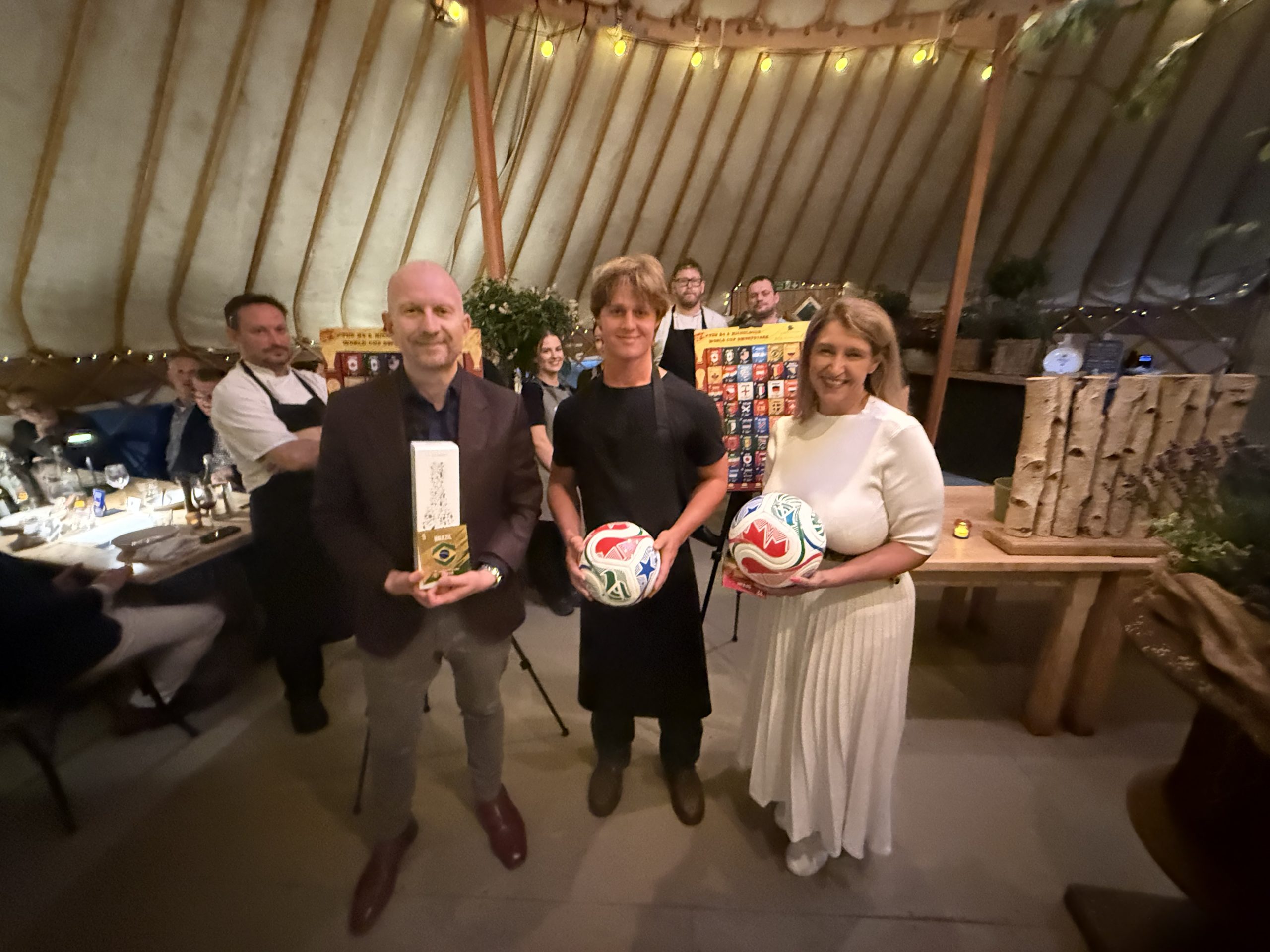
At the recent B4 Signature dinner hosted at The Yurt at Nicholsons in North Aston, we set out to answer a simple question:
Can we predict the future?
Business leaders spend much of their time doing exactly that. We forecast sales, predict market trends, assess risks, evaluate opportunities and make investment decisions based on what we think will happen next.
So, inspired by the FIFA World Cup, we decided to run a social experiment.
The objective was simple: test four different approaches to forecasting and see how they compare.
The four approaches were:
- Reality – the actual FIFA World Cup – we’ll discover this on 19th July.
- Human Judgement – the collective wisdom of the room.
- The ChatGPT Prediction – AI’s assessment based on available knowledge and analysis.
- Human + AI – a World Cup simulation generated from audience inputs and processed by AI.
The experiment also had a charitable purpose, with guests invited to purchase a randomly allocated World Cup nation in support of charity which, thanks to the hard work of Sobell House’s Nikki Gracey raised £925 for Raise, B4’s annual fundraising initiative.
The evening took place at The Yurt, a venue our B4 Review Expert Ruth Hawkins reviewed last year in an article titled:
“The Yurt – One Year On, My Recommendation Remains The Same: Make Sure You Visit.”
See the article here: The Yurt Review
A year later, we can safely say Ruth’s recommendation remains unchanged.
The atmosphere, food, hospitality and unique setting once again provided the perfect backdrop for a B4 gathering and an evening that was designed to be both thought-provoking and entertaining.
Competition One: The People’s Choice
Guests were asked a straightforward question:
Who do you think will win the FIFA World Cup?
No statistics.
No algorithms.
No AI.
Just instinct, experience and football knowledge.
After all the votes had been counted, one nation emerged as the clear favourite.
Spain. Winner – Natalie Pierre-Davis of Abingdon & Witney College
The wisdom of the room had spoken.
Competition Two: The ChatGPT Prediction
We thought it was only fair to ask AI for its opinion.
Before the event, ChatGPT was asked:
“Based on everything you know about football, who do you think will win the FIFA World Cup?”
Its answer was recorded and sealed before the evening began.
When the envelope was eventually opened, ChatGPT had arrived at exactly the same conclusion as the room.
Spain. Winner – Natalie again although 2nd place went to Brazil held by Andre Vaux of Aura
Without any knowledge of the guests’ votes, both human judgement and AI analysis independently selected the same nation.
Competition Three: The Human + AI World Cup
This was where things became particularly interesting.
Rather than asking AI to predict the winner, we created an entirely new World Cup tournament.
Guests generated the inputs.
AI generated the outcomes.
Using a scoring system based on the number of letters in guests’ first names, hundreds of scores were created and fed into an AI-generated tournament.
Every group match, knockout tie and final was calculated throughout the evening.
What followed was exactly the kind of unpredictability that makes both football and forecasting so fascinating.
Traditional favourites fell by the wayside.
Unexpected nations emerged.
And after a remarkable journey through the knockout stages, the Human + AI World Cup produced an unlikely semi-final line up and champion:
Semi-Finalists: Austria, Bosnia & Herzegovina, Turkey and Tunisia!
Winner – Austria.
The winning nation was held by Milo Brooke-Little, who became our Human + AI World Cup Champion.
So What Did We Learn?
Perhaps the most interesting outcome wasn’t who won.
It was the contrast between the different methods.
The room selected Spain.
ChatGPT selected Spain.
The Human + AI simulation selected Austria.
And reality?
Reality is still writing its own story.
The actual FIFA World Cup winner remains unknown.
In a few weeks’ time we’ll discover whether the crowd was right, whether AI was right, whether Austria’s remarkable simulated run was a glimpse into the future, or whether reality had something entirely different in mind.
Forecasting, Business and Uncertainty
While the experiment was deliberately light-hearted, it highlighted a serious business challenge.
Every organisation relies on forecasting.
Some forecasts are based on experience.
Some are based on data.
Some increasingly rely on artificial intelligence.
And many are a combination of human insight and AI-powered analysis.
The reality, of course, is that no forecast is ever guaranteed.
The future has a habit of surprising us.
That’s what makes forecasting valuable.
And that’s what made this World Cup Prediction Experiment such an enjoyable reminder that while we can all make our best predictions, reality always has the final say.
We’ll report back once the World Cup has concluded and reveal whether Spain, Austria or another nation altogether becomes the ultimate winner.
And if you’re looking for somewhere to host your own business event, celebration or simply enjoy a memorable evening, our recommendation remains exactly what it was a year ago:
Make sure you visit The Yurt.