1787561575128
Related Company: Intertronics

The 50% Problem Is Back

30th Sep 2026

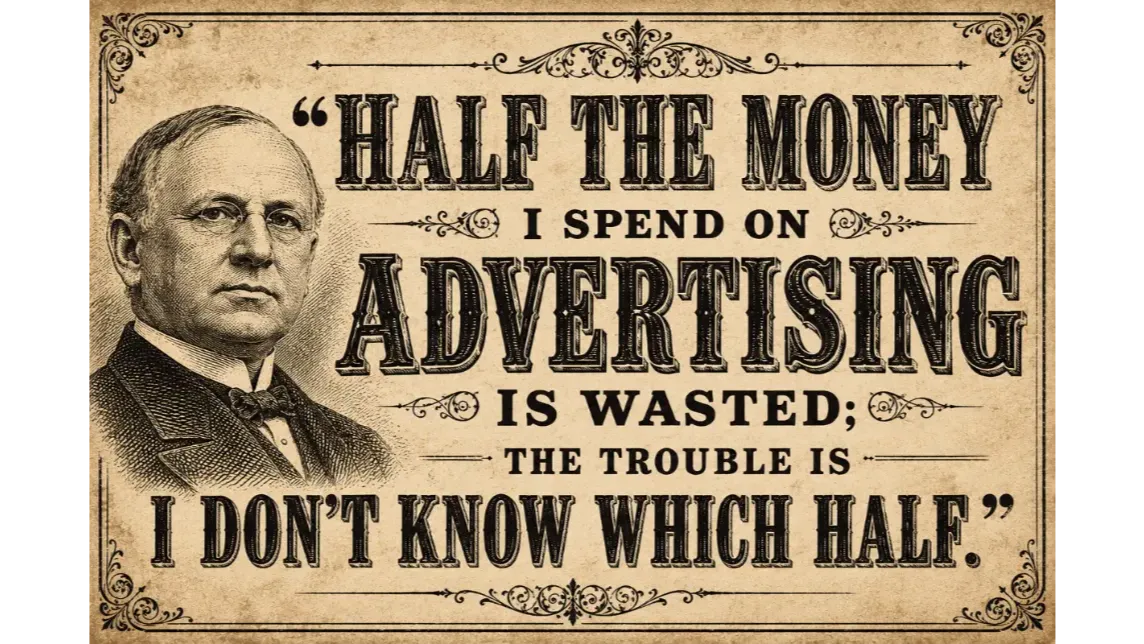
“Half the money I spend on advertising is wasted; the trouble is I don’t know which half.”

It’s an old line, usually attributed to the American retailer John Wanamaker. He lived from 1838 to 1922 and built his advertising-heavy retail business from the 1860s onwards. He was considered to be a pioneer in marketing. Wanamaker was the first retailer to place a half-page newspaper ad (1874) and the first full-page ad (1879). The quotation is associated with this era when modern mass advertising was developing, roughly the 1880s to 1900s.

Maybe what Wanamaker said is true today.

For much of the past twenty years or so, digital marketing appeared to have solved the Wanamaker problem. We could measure impressions, clicks, opens, conversions, cost per lead and, ultimately, return on marketing investment. We could see where people came from, what they looked at, and what they did next. Marketing acquired dashboards and attribution models and became much more accountable.

And much of that was genuinely useful. Especially because small businesses have ready access to these metrics. You don’t need some fancy and expensive analysts to give you feedback.

What’s working, and how can we do more of it?

Today, anyone involved with marketing communications will tell you that our world is changing, and changing real fast. We throw out words like “zero clicks” and “AI search” and “GEO” to justify or explain why the metrics we have used for the last few decades have tanked, or plummeted, or are… just gone. And this isn’t just a measurement problem. The things we did before, and thought we understood, don’t seem to work in quite the same way anymore. We don’t know what’s working. And that’s, um, awkward. Wanamaker might recognise the problem.

Several things are pushing us back towards uncertainty:

  • Attribution is deteriorating – privacy restrictions, cookie loss, cross-device behaviour, dark social, AI search and zero-click searches make the customer journey increasingly difficult to reconstruct.
  • Buying journeys are messy – particularly in B2B, someone can encounter us repeatedly over months or years before the eventual enquiry. The thing we can measure may simply be the final touch.
  • AI is changing discovery – a useful piece of content might influence an AI-generated answer without generating a visit to our website at all.
  • Recognition is inherently difficult to attribute – seeing our brand repeatedly in trade media, Google, LinkedIn, YouTube and elsewhere may make someone more likely to trust us when a problem arises. Which exposure gets the credit? We don’t know. I’m not even sure there is a sensible reason why one of them should.
  • The measurable can crowd out the valuable – do we risk optimising for clicks because clicks are countable, while underinvesting in authority, reputation and recognition because they aren’t.

Add all these together and there are simply fewer measurable touch points. More of the customer journey is disappearing from view.

And then there is timing. Much of our marketing happens when the customer isn’t actually buying anything. An engineer may encounter us today and not have a relevant problem to solve for another year. What I want that marketing to have achieved is quite modest: when that problem eventually arrives, we’re not strangers. “I’ve seen these people before.” Good luck putting a reliable number against that.

Measurable doesn’t necessarily mean effective

This creates another problem. What we can measure can easily become what we optimise. Clicks are countable, so we optimise for clicks. Leads are countable, so we optimise for leads.

But what I think helps us win business is recognition with the right associations, alongside reputation, authority and trust. I want someone with a manufacturing problem to think, “I’ve seen these people before, they know about this stuff.” These things are really hard to measure, at least objectively and in SME land. In order to not throw my hands up in the air and decide that all marketing is luck, I want to try and think about it in this sort of structure:

Activity → Evidence → Effect

Coverage, impressions, articles, videos and posts are activity.

Search visibility, engagement, branded search, repeat exposure and enquiries are evidence that something may be happening.

Recognition, authority, consideration and, eventually, purchasing behaviour are the effects we’re actually trying to create.

The mistake is taking an activity metric, particularly one that happens to be easy to count, and calling it effectiveness. Part of the problem is that marketing often works cumulatively, while attribution tries to work out which individual thing worked.

This isn’t an argument against measurement

None of this means I want less measurement. But I am starting to question what some of the numbers actually tell me. Digital gave us vastly more data, but not necessarily vastly more knowledge. Counting clicks tells me how many people clicked – I’m increasingly wary of assuming it tells me how well the marketing worked. I’m still trying to get my head around whether we can really measure LLM chatbot activity for our brand, other than the relatively small number of clicks that come through from ChatGPT and elsewhere. If an AI uses something we’ve published to help answer an engineer’s question, what exactly am I supposed to measure?

For twenty years, digital marketing appeared to solve Wanamaker’s 50% problem. Perhaps it never really did. It gave us the ability to measure an enormous number of things and, somewhere along the way, encouraged us to confuse measurement with effectiveness. Now the customer journey is becoming harder to observe just as some of the things we most want to achieve – recognition, authority, reputation and being remembered at the moment of need – are becoming more important.

Maybe we’re back to wondering which half of our marketing is wasted. Except this time we’ve got a very impressive dashboard to look at while we wonder.

Back to news

The 50% Problem Is Back

30th Sep 2026
1787561575128
Related Company: Intertronics

“Half the money I spend on advertising is wasted; the trouble is I don’t know which half.”

It’s an old line, usually attributed to the American retailer John Wanamaker. He lived from 1838 to 1922 and built his advertising-heavy retail business from the 1860s onwards. He was considered to be a pioneer in marketing. Wanamaker was the first retailer to place a half-page newspaper ad (1874) and the first full-page ad (1879). The quotation is associated with this era when modern mass advertising was developing, roughly the 1880s to 1900s.

Maybe what Wanamaker said is true today.

For much of the past twenty years or so, digital marketing appeared to have solved the Wanamaker problem. We could measure impressions, clicks, opens, conversions, cost per lead and, ultimately, return on marketing investment. We could see where people came from, what they looked at, and what they did next. Marketing acquired dashboards and attribution models and became much more accountable.

And much of that was genuinely useful. Especially because small businesses have ready access to these metrics. You don’t need some fancy and expensive analysts to give you feedback.

What’s working, and how can we do more of it?

Today, anyone involved with marketing communications will tell you that our world is changing, and changing real fast. We throw out words like “zero clicks” and “AI search” and “GEO” to justify or explain why the metrics we have used for the last few decades have tanked, or plummeted, or are… just gone. And this isn’t just a measurement problem. The things we did before, and thought we understood, don’t seem to work in quite the same way anymore. We don’t know what’s working. And that’s, um, awkward. Wanamaker might recognise the problem.

Several things are pushing us back towards uncertainty:

  • Attribution is deteriorating – privacy restrictions, cookie loss, cross-device behaviour, dark social, AI search and zero-click searches make the customer journey increasingly difficult to reconstruct.
  • Buying journeys are messy – particularly in B2B, someone can encounter us repeatedly over months or years before the eventual enquiry. The thing we can measure may simply be the final touch.
  • AI is changing discovery – a useful piece of content might influence an AI-generated answer without generating a visit to our website at all.
  • Recognition is inherently difficult to attribute – seeing our brand repeatedly in trade media, Google, LinkedIn, YouTube and elsewhere may make someone more likely to trust us when a problem arises. Which exposure gets the credit? We don’t know. I’m not even sure there is a sensible reason why one of them should.
  • The measurable can crowd out the valuable – do we risk optimising for clicks because clicks are countable, while underinvesting in authority, reputation and recognition because they aren’t.

Add all these together and there are simply fewer measurable touch points. More of the customer journey is disappearing from view.

And then there is timing. Much of our marketing happens when the customer isn’t actually buying anything. An engineer may encounter us today and not have a relevant problem to solve for another year. What I want that marketing to have achieved is quite modest: when that problem eventually arrives, we’re not strangers. “I’ve seen these people before.” Good luck putting a reliable number against that.

Measurable doesn’t necessarily mean effective

This creates another problem. What we can measure can easily become what we optimise. Clicks are countable, so we optimise for clicks. Leads are countable, so we optimise for leads.

But what I think helps us win business is recognition with the right associations, alongside reputation, authority and trust. I want someone with a manufacturing problem to think, “I’ve seen these people before, they know about this stuff.” These things are really hard to measure, at least objectively and in SME land. In order to not throw my hands up in the air and decide that all marketing is luck, I want to try and think about it in this sort of structure:

Activity → Evidence → Effect

Coverage, impressions, articles, videos and posts are activity.

Search visibility, engagement, branded search, repeat exposure and enquiries are evidence that something may be happening.

Recognition, authority, consideration and, eventually, purchasing behaviour are the effects we’re actually trying to create.

The mistake is taking an activity metric, particularly one that happens to be easy to count, and calling it effectiveness. Part of the problem is that marketing often works cumulatively, while attribution tries to work out which individual thing worked.

This isn’t an argument against measurement

None of this means I want less measurement. But I am starting to question what some of the numbers actually tell me. Digital gave us vastly more data, but not necessarily vastly more knowledge. Counting clicks tells me how many people clicked – I’m increasingly wary of assuming it tells me how well the marketing worked. I’m still trying to get my head around whether we can really measure LLM chatbot activity for our brand, other than the relatively small number of clicks that come through from ChatGPT and elsewhere. If an AI uses something we’ve published to help answer an engineer’s question, what exactly am I supposed to measure?

For twenty years, digital marketing appeared to solve Wanamaker’s 50% problem. Perhaps it never really did. It gave us the ability to measure an enormous number of things and, somewhere along the way, encouraged us to confuse measurement with effectiveness. Now the customer journey is becoming harder to observe just as some of the things we most want to achieve – recognition, authority, reputation and being remembered at the moment of need – are becoming more important.

Maybe we’re back to wondering which half of our marketing is wasted. Except this time we’ve got a very impressive dashboard to look at while we wonder.

Back to news